
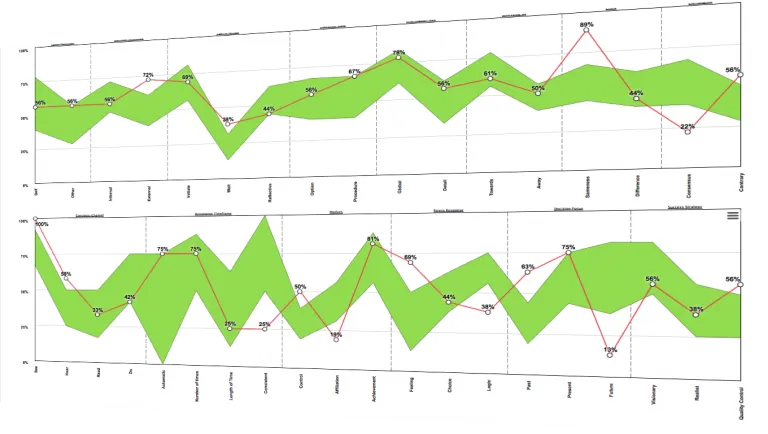



Master the Science and Practice of Leadership Intelligence
Become a Certified Leadership Intelligence Coach with a proven step-by-step framework built on Behavior Intelligence.
The Certification Journey:
3 Core Pillars
Behavior Intelligence Foundations
Understand and map human behavior scientifically
Leadership Intelligence Application
Apply behavior science to coaching and leadership
Business Launch and Growth
Build, market, and scale your coaching business
Pillar 1: Behavior Intelligence Foundations
Module 1: Introduction to Behavior Intelligence (BIQ)
Behavior as the most actionable lens for coaching
Neuroscience principles behind BIQ
Module 2: Mapping Behavior Patterns
AccuMatch Methodology Overview
Practice mapping real behaviors
Module 3: Changing Behavior Patterns
Intervention models
Practical coaching frameworks for lasting change
Pillar 2: Leadership Intelligence Application
Module 4: Coaching Leaders Using Behavior Intelligence
Identifying leadership styles through behaviors
Coaching executives for performance outcomes
Module 5: Leading Teams with BIQ
Group dynamics and organizational behavior mapping
Behavior-based team development strategies
Module 6: Conflict Resolution & Communication Mastery
Using BIQ to prevent and resolve leadership breakdowns
Pillar 3: Business Launch and Growth
Module 7: Building Your Coaching/Consulting Business
Defining your niche and offer
Pricing and packaging your services
Module 8: Marketing for Coaches and Consultants
Messaging that converts
Using behavior triggers in marketing
Module 9: Scaling Your Practice
Group programs, corporate contracts, licensing opportunities
Bonus Masterclasses Included:
Topics could include:
Neuroscience and Leadership
Advanced Behavior Mapping Techniques
Behavior Intelligence for Change Management
Your Certification Journey: Simple and Supportive

Inquire and Enroll

Complete Online and Live Training Modules

Practice with Real Clients
(Practice cohort support)

Certification Assessment
(Coach live or submit client cases)

Launch with Full Business Platform and Community Support
To Earn Your Certification:
Complete all online modules
Attend 2 live practicums (or submit client sessions)
Pass final case study or practical
80% minimum attendance/participation
Ready to Launch Your Future as a Certified Leadership Intelligence Coach?
Real Coaches.
Real Success.

"I’ve been coaching for over a decade, but the BIQ certification completely changed how I work with clients. Understanding their behavior patterns—not just their feelings—gave me a new level of precision. My client retention and referrals have never been higher."
Lena Morales, Executive Coach
"BIQ helped me launch my coaching business fast—with structure, confidence, and real clients."
David Chan, Former VP
"We rolled out BIQ inside our leadership development program. The impact was immediate. Managers became more self-aware, team dynamics improved, and performance conversations finally got real. It’s not just a certification—it’s a competitive edge."
Rachel Owens, Learning & Development Director, UK
Latest From The Blog

Remove Friction, Reinforce FLOW
Why Small Obstacles Kill Big Initiatives—And How to Engineer Frictionless Execution
There is a simple truth about human behavior: behavior always follows the path of least resistance. When friction is high, progress slows. When friction is removed, flow emerges. And when flow emerges, performance transforms.
In organizations, most failures are not caused by people—they are caused by systems that unintentionally create resistance. The role of leadership is not just to motivate people, but to design environments where the right behaviors are also the easiest behaviors.
Let’s explore how to remove friction, reinforce flow, and engineer execution that works.
Understanding Friction: The Hidden Force Behind Performance
Friction is any obstacle—small or large—that makes the right action harder than it should be. Often, it is invisible until results begin to suffer.
In Behavior Intelligence, we study how systems influence unconscious behavior patterns. Habits form automatically based on environment, effort, and perceived resistance. If your system creates unnecessary effort, people will naturally avoid it—even when they have the best intentions.
Leadership, therefore, must shift from blaming people to analyzing systems.

Identify Friction Before Failure
Most breakdowns do not happen suddenly. They build slowly through small, repeated obstacles—what I call death by a thousand cuts.
Consider a common example:
Overloaded onboarding processes
Too much information too quickly
Slow system setup
Complex instructions
The result? Overwhelm, disengagement, and drop-off.
The lesson:
Look at the journey, not just the outcome.
Observe:
Where do people pause?
Where do they hesitate?
Where do they seek workarounds?
Where do they stop entirely?
Friction always reveals itself through behavior—if you are watching closely enough.

The Power of Micro-Friction
Small inefficiencies multiply into massive losses over time.
A simple formula to understand impact:
Friction × Frequency × People = Magnitude of Loss
Even one unnecessary step, repeated daily across a team, becomes thousands of wasted actions—and hours of lost productivity.
Common micro-frictions include:
Extra clicks in systems
Switching between platforms
Manual data entry
Searching for information
Repeated logins
Individually, they feel trivial. Collectively, they destroy momentum.
When to Add Friction (Yes, Sometimes You Should)
Not all friction is bad. Strategic friction improves quality, decision-making, and outcomes.
Examples of productive friction:
Confirmation before sending mass communication
Review steps before publishing
Cooling-off periods before major decisions
Clear visibility of consequences (cost, timing, policies)
Speed is not always success. Sometimes, a pause prevents expensive mistakes.
The key is intentional design.
Ask:
Where should we slow decisions to improve quality?
Where does added reflection reduce risk?
Where does speed harm long-term outcomes?
Protecting FLOW: The Engine of Deep Work
Flow is the state where focus, productivity, and engagement align. But flow is fragile.
Every interruption—noise, messages, context switching—breaks concentration and requires time to recover.
Different roles require different friction environments:
High-focus roles (engineering, strategy, design):
Require uninterrupted flow zones
Sensitive to noise and interruptions
Thrive in deep work blocks
Rapid-response roles (sales, support, operations):
Function in short bursts
Interruptions are part of the role
Speed outweighs depth
Design for the role, not the organization.
Practical flow protection tactics:
Dedicated deep-work blocks (2–4 hours)
No-meeting windows
Do-not-disturb modes
Visual signals for focus time
Clear respect for uninterrupted work
Protect flow, and performance follows.
Measure Friction, Not Just Results
Most organizations measure outcomes—but outcomes are lagging indicators.
By the time results decline, friction has already done its damage.
Instead, measure the experience:
Time to complete tasks
Steps required
Error rates
Drop-off points
Abandonment moments
User journey quality
If you only measure conversion, productivity, or output, you miss what happens before the result.
Fix friction early, and results improve naturally.

Continuous Improvement Beats Big Overhauls
Organizations often attempt massive transformations. But lasting change rarely comes from big launches—it comes from continuous small fixes.
A smarter approach:
Test early, adjust often
Improve incrementally
Remove friction continuously
Gather feedback frequently
Empower teams to identify obstacles
Progress is not a single event. It is a system of ongoing refinement.
The Six-Step Framework to Remove Friction and Reinforce FLOW
Map the Friction Journey
Walk through the process as a user. Identify pauses, resistance, and breakdowns.Calculate the Impact
Measure how small obstacles multiply across time, people, and frequency.Add Strategic Friction Where Needed
Improve decision quality, reduce risk, and protect outcomes.Design Role-Specific Flow Zones
Protect deep work where concentration matters most.Measure Experience, Not Just Outcomes
Track friction indicators before results decline.Continuously Improve in Small Steps
Small, consistent fixes outperform large, delayed transformations.
The Leadership Mindset Shift
If your organization feels stuck, do not start by asking:
“What is wrong with our people?”
Instead ask:
“Where is friction preventing the right behavior?”
Because when systems change, behavior changes.
And when behavior changes, results follow.
This is the essence of Behavior Intelligence—designing environments where performance becomes natural, not forced.
Your Next Step
If you are ready to:
Remove hidden friction from your organization
Create environments where flow and performance thrive
Design systems where the right behaviors become automatic
Explore Leadership Intelligence and Behavior-Driven Design.
Learn more. Apply the framework. Transform execution.
Apply now or join the next program to begin engineering frictionless performance.

Subscribe to our Newsletter!
Get the latest insights on coaching, behavior intelligence, & leadership.


Copyright 2026 • All Rights Reserved
Behavior Intelligence Organization is a Division of NLP Profiles Inc.
Terms of Use | Privacy Policy
Subscribe to our Newsletter!
Get the latest insights on coaching, behavior intelligence, & leadership.
Copyright 2025 • All Rights Reserved
Behavior Intelligence Organization is a Division of NLP Profiles Inc.
Terms of Use | Privacy Policy